TrellisWare Integration Scale Test - July 2026
TrellisWare Scale Test – 150+ Live Nodes San Diego, CA | July 2026 | TerraKinesis + TrellisWare Joint Test | Public

Making Communication Possible At Scale
151 — Nodes in Network
100% — Delivery Rate with PULSE vs. 75% for Baseline at n=151
100% — Messages Delivered with Simulated Jamming vs. 0% for Baseline at n=150
Baseline network collapses under simulated jamming conditions. PULSE holds at 100% – same radios, same channel. Figures from TerraKinesis field data record onsite. Jamming is simulated by imposing a random 30% packet loss.
TerraKinesis expects to return to TrellisWare’s lab this fall to validate an expanded 800+-node configuration.
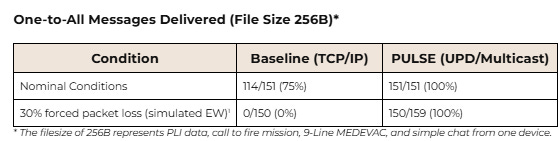
The following table shows raw test results for successful message delivery over a 1.2 MHz TrellisWare radio frequency channel.
Background
TrellisWare Inc. builds the TSM tactical radio waveform upon which TerraKinesis (TK) validated its PULSE software at 20 nodes during Dragon Nexus 26-01 with the XVIII Airborne Corps. This test moved the same PULSE software onto TrellisWare’s own bench in San Diego, CA to find out how far it could scale.
TK demonstrated PULSE using TrellisWare’s 1.2 MHz channel, which is a narrowband relative to typical tactical radio configurations that often run wider (multi-MHz) channels for higher throughput. Narrower channels trade capacity for range, resilience to jamming, and a lower probability of interception or detection — making them the harder, more representative test case for contested environments. Demonstrating PULSE’s overhead reduction on a constrained 1.2 MHz channel is a more demanding proof point than the same result on a wider channel, since overhead consumes a larger share of the available capacity.
Over twenty people from both companies — engineers, product specialists, and business development leads from TK and TrellisWare — spent three days configuring radios, tuning payload sizes, and pushing the node count to 151, far beyond the point where standard networks break down.
The Challenge
Think of a radio network like kids talking to each other across a classroom. With half a dozen kids, it’s easy — everyone hears everyone. Add more kids, and more of them start talking over each other, points get lost, and someone has to keep repeating themselves out loud. That’s what happens to standard networking as node count grows: at 150 live nodes, TrellisWare’s own baseline held a 76% delivery rate with the room otherwise quiet.
Now, add real-world noise: jamming, RF interference, dropped packets. Our test at TrellisWare imposed a 30% simulated packet loss to mimic a contested environment. The Baseline message delivery rate didn’t just wane—it went to zero (0).
That’s the capability gap that PULSE is built to close. PULSE ensures every note gets delivered, no matter how many kids are in the classroom or how noisy it gets.
The Solution
TK deployed PULSE — the same firmware-based, distributed compute protocol demonstrated at Dragon Nexus — across TrellisWare TSM radios paired with Raspberry Pi endpoint nodes. This test used COTS components—no new hardware and no infrastructure changes. We put to the test the same NACK protocol, Beehive Grouping, and ELMF architecture that held the line at Fort Bragg except, instead of 20 nodes, we have pushed to a much larger 151-node network.
Under a 30% simulated packet loss to mimic a contested environment, the baseline message delivery rate didn’t just wane—it went to zero (0).
Results
Result 1 — Guaranteed Performance at Scale
PULSE sustained 100% message delivery at 151 live nodes with zero induced jamming. TrellisWare’s native baseline networking, same radios, same channel, held only 76% delivery at the same node count. This indicates a 32% improvement over the Baseline.
Baseline: 76% delivery success | PULSE: 100% delivery success
Result 2 — Guaranteed Performance in Contested Conditions
With 30% simulated packet loss—representative of contested RF conditions — Baseline delivery collapsed to 0% while PULSE held at 100%. This isn’t just a marginal improvement: it’s a new tactical capability.
Baseline: 0% delivery success, jammed | PULSE: 100% delivery success, jammed
Result 3 — 7-fold Increase in Proven Node Capacity
TK scaled the live test to 151 devices on TrellisWare TSM radio and Raspberry Pi endpoint nodes. The number of nodes tested was constrained by hardware availability. PULSE’s upper node limit, if any, is yet to be determined.
Baseline: 20 nodes at Dragon Nexus | PULSE: 151 nodes at TrellisWare
Payload for the Primary Test: 1KB messages (256 bytes, sent four times to each node). Node count was limited by the number of physical radios TrellisWare had racked onsite – Not by PULSE itself.
Key Technical Capabilities Demonstrated
NACK Protocol — only signals when a message is missing, instead of confirming every single one, cutting overhead by 95–99% versus ACK-based approaches
Beehive Grouping (proprietary algorithm) — scales node clusters linearly (O(n)) instead of exploding in complexity (O(n²)) as competing approaches do
ELMF Architecture — <50 microsecond per-message latency with high delivery rates under packet loss conditions representative of contested RF environments
Backwards Compatibility — deployed as firmware on TrellisWare TSM radios already in the field, with Raspberry Pi devices as endpoint nodes
Network Capacity on Fielded Hardware — 100% delivery rates in normal and simulated jamming conditions for up to 151 nodes vs. baseline rates of 0%
Operational Impact
The most recent TrellisWare testing provided a seven-fold increase in network capacity. That’s 30 next-gen-capable soldiers per backhaul instead of 4, or 150 devices—swarm drones, vehicles, sensors—instead of 20. Increasing network resilience allows commanders to stay nimble and to increase awareness of the battlefield, ultimately closing the huge survivability gap attributed to the limitations of traditional networking.
Call for fire — Real-time targeting data reaches the fire mission without delay or message loss.
Casualty: 9-line MEDEVAC — Critical patient data transmits under contested conditions, when every second counts.
Position reporting — Continuous troop and asset location data flows across the formation without SATCOM.
That’s the jump from Dragon Nexus 26-01 to this test: going from a 20-node network to a 151-node network isn’t just “more of the same,” it’s an entirely different coordination problem, and PULSE held it together.
PULSE’s upper node limit, if any, is yet to be determined.
For units built around distributed formations — vehicles, sensors, and dismounted soldiers all talking at once — this means real-time position reporting, targeting data, and casualty reports can keep moving at a scale that standard networking simply can’t support, especially once jamming enters the picture.
Path Forward
Successful scale validation on TrellisWare’s own bench strengthens the case TK is building with the Army: The same protocol that held 151 notes under jamming is the protocol that can hold more than 1,000. Our future test with TrellisWare targeting 800+ nodes will establish a key proof point for the PULSE protocol. The path to TRL 7 culminates with testing in an operational environment.
Same radios. Same waveform. No new hardware required. 150+ nodes, holding under jamming. Documented July 2026.
XVIII Airborne Corps invited TK to Dragon Nexus 26-02. The Scope of Work includes integration with a large number of nodes and will include soldier touch points, bringing PULSE closer to TRL 7. TerraKinesis is also preparing for an upcoming report from U.S. Army C5ISR DEVCOM. Additional details are available upon request.
Timeline:
July 2026 — TrellisWare, 150+ Physical Nodes. Joint TrellisWare test event. Scaled PULSE past the 20-node ceiling shown at Dragon Nexus to 151 devices on live TSM radios.
August 2026 — C5ISR DEVCOM Testing. Required to reach TRL 7. Army-directed evaluation in an operational environment.
September 2026 — TrellisWare, 800+ Physical Nodes. TerraKinesis expects to return for expanded testing on TrellisWare configuration closing the gap to a 1,000+ node target.
H2 2027 — NGC2 Prime Contract, First Tranche. XVIII Airborne Corps · Widens the commercial pathway.
About TerraKinesis
TerraKinesis is a Detroit-based defense technology company founded by a combat veteran and deep-tech engineers to solve one of the hardest unsolved problems in distributed computing: guaranteed message delivery at scale, without a server, without satellite, and without the network failing when it matters most. The company built PULSE — the infrastructure layer for contested, denied, and degraded environments — and is backed by strategic defense and commercial investors.
Glossary
Terms are defined as used in this document. Military terminology follows U.S. Army doctrinal usage.
Beehive Grouping — TerraKinesis’s patent-pending node organization architecture. Groups nodes into clusters that scale linearly — O(n) — rather than the exponential O(n²) growth that causes network collapse in competing approaches.
Barrage Relay — A TrellisWare TSM radio operating in relay mode, extending the range of a tactical mesh network by forwarding traffic between nodes that cannot communicate directly. Used in the Dragon Nexus Result 26-01.
C5ISR DEVCOM — Command, Control, Communications, Computers, Cyber, Intelligence, Surveillance, and Reconnaissance Development Command. The Army organization responsible for testing and validating communication technologies. Required for TRL 7 certification.
COTS — Commercial Off The Shelf. Industry shorthand for parts that are readily available for purchase.
CPE C2 — Common Platform Environment Command and Control. The U.S. Army program established a unified software and hardware standard for battlefield command and control across all platforms and echelons. Dragon Nexus 26-01 was initiated by the CPE C2 Trail Boss.
CSO — Commercial Solutions Opening. A DoD acquisition vehicle that allows the government to competitively solicit and acquire commercial technologies without a traditional contract award process.
ELMF — Efficient Large Message Fragmentation. TerraKinesis’s architecture for breaking large messages into fragments, transmitting them across the mesh, and reassembling them at the destination — maintaining sub-50 microsecond per-message latency even under contested RF conditions.
NACK Protocol — Negative Acknowledgment. Instead of confirming every message received (ACK), PULSE only signals when a message is missing. This reduces network overhead by 95–99% compared to standard ACK-based protocols.
NGC2 — Next Generation Command and Control. The U.S. Army program modernizing battlefield command and control infrastructure.
Node — A single end-user, smart device with computing on the network. Could be a sensor, phone, radio, or location transmitter.
OTA — Other Transaction Authority. A flexible DoD procurement mechanism that allows faster acquisition outside of traditional Federal Acquisition Regulation requirements.
Payload — The actual data being sent from device to device. A 256 B payload is enough to store a short SMS text message, a single URL, or a very brief email draft.
Position Location Information (PLI) — the GPS data that tracks the exact spots of soldiers, vehicles, or assets in real time. This helps teams safely know where everyone is.
Radio Frequency (RF) — The portion of the electromagnetic spectrum used to transmit wireless signals between devices. In military operations, RF is the invisible highway that carries communications between radios, sensors, vehicles, and command systems. A contested RF environment is one where an adversary is actively jamming, spoofing, or degrading that signal — flooding the highway with noise or closing down lanes so messages crash before they arrive.
SATCOM — Satellite Communications. A connection between ground-based infrastructure and an orbiting satellite. Expensive, limited in capacity, and unavailable in denied or contested environments.
TAK / ATAK — Team Awareness Kit / Android Team Awareness Kit. The U.S. military’s primary situational awareness application. Displays troop positions, GPS coordinates, and battlefield intelligence in real time.
TCP/IP — The standard internet communication protocol. Requires a confirmed handshake for every message sent, generating at least 2 overhead messages for every 1 delivered. Designed for stable, connected networks — not contested or denied environments.
TrellisWare TSM — A tactical software-defined radio waveform used by the U.S. military for mesh networking. The hardware platform on which PULSE was deployed at Dragon Nexus.
TRL — Technology Readiness Level. A 1–9 scale used by the U.S. Department of Defense to measure the maturity of a technology. TRL 6 = demonstrated in a relevant environment. TRL 7 = demonstrated in an operational environment.
UDP/Multicast — A lightweight messaging protocol that sends one packet to many recipients simultaneously without requiring individual confirmation. PULSE uses UDP/multicast as its transport layer.